ADAS Recalibration After Windshield Replacement
If your vehicle has lane-keep assist or automatic emergency braking, the camera that runs it lives behind the windshield. Replace the glass and that camera has to be recalibrated.
Call (737) 843-0004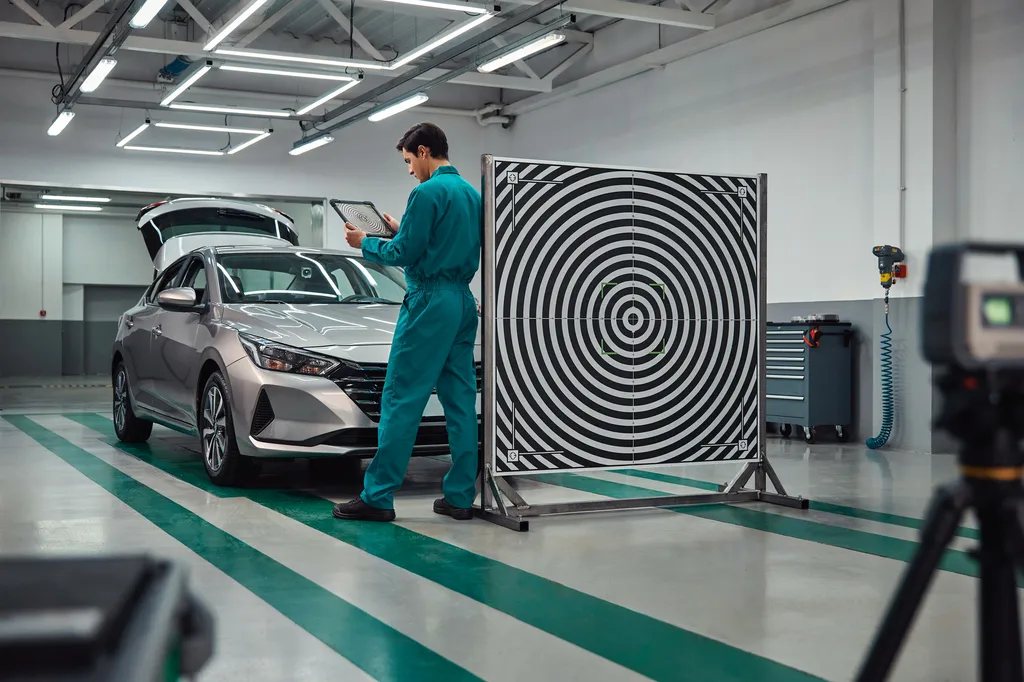
ADAS Calibration Leander TX — the Short Answer
ADAS calibration Leander TX is required on most 2018-and-newer vehicles after windshield replacement, because the forward camera behind the glass has to be re-aimed to the new pane before lane-keep, adaptive cruise, or automatic emergency braking can trust what it sees. It’s either a static calibration (target board, controlled space), a dynamic calibration (a calibration drive), or both, depending on the manufacturer. Through comprehensive insurance it’s normally covered in the same glass claim.
What ADAS is and where it lives
ADAS stands for Advanced Driver Assistance Systems: lane departure warning, lane-keep assist, adaptive cruise control, automatic emergency braking, traffic sign recognition. On most vehicles the forward-facing camera that drives all of it is mounted to a bracket bonded to the inside of the windshield, usually behind the mirror.
That camera was aimed at the factory to a tolerance measured in fractions of a degree. Take the old glass out and set new glass in, and the camera is now looking somewhere very slightly different. It has to be recalibrated to the new glass or it reads the road wrong.
Why a fraction of a degree matters
A camera aimed less than one degree off is looking at a spot roughly two feet from where it thinks it is by the time the view reaches 100 feet down the road. That is the difference between a lane-keep system tracking the center of your lane on the 183A and one drifting you toward the shoulder, or an automatic braking system that reads a stopped car half a second late.
This is not an upsell. An uncalibrated ADAS system is worse than no system at all, because you still trust it.
Static vs dynamic calibration
- Static calibration uses a printed target board set at a precise distance and height in front of the vehicle on level ground. Common on Honda, Subaru, Toyota, and most European vehicles.
- Dynamic calibration requires driving the vehicle at a steady speed on a well-marked road while a scan tool teaches the camera. Common on Ford and GM.
- Both are required by some manufacturers, in sequence. We confirm which your vehicle needs before we dispatch.
Which Calibration Your Vehicle Needs, by Manufacturer
The calibration method isn’t a choice we make — it’s set by the manufacturer. Here’s what the vehicles we see most in Leander typically require.
| Manufacturer | Typical calibration | Example model |
|---|---|---|
| Toyota | Static | RAV4 (Toyota Safety Sense) |
| Subaru | Static, dual-camera | Outback (EyeSight) |
| Honda | Static | Civic, CR-V (Honda Sensing) |
| Ford | Dynamic | F-150 |
| Chevrolet / GM | Dynamic | Silverado 1500 |
| Tesla | Static | Model 3 (Autopilot) |
| European makes (BMW, Audi, Mercedes) | Static, often dealer-level | Most current models |
These are typical patterns, not guarantees — calibration requirements can change by trim and model year even within the same manufacturer. We confirm the exact requirement for your specific vehicle before we dispatch, not after we arrive.
Why Skipping Calibration Is Worse Than Having No ADAS at All
Front crash prevention and lane-keep systems are genuinely effective when they’re aimed correctly — independent crash-test research from the Insurance Institute for Highway Safety has documented real reductions in crash rates from properly functioning automatic emergency braking and lane-keep systems. That effectiveness depends entirely on the camera actually pointing where the software thinks it’s pointing.
An uncalibrated system doesn’t announce that it’s wrong. It keeps working, keeps showing you the same dashboard icon, and keeps making decisions — just based on a camera that’s aimed slightly off after the glass was replaced. That’s the exact scenario that turns a safety system into a liability.
Is calibration covered by insurance?
When recalibration is required as a direct result of a covered windshield replacement, insurers generally cover it as part of the same glass claim. It is documented as a separate operation with its own line, but it falls under the same claim and, on most full-coverage policies, the same deductible treatment as the glass.
Tell us your year, make, and model when you call and we will tell you before dispatch whether your vehicle needs calibration and which type.
Frequently asked questions
Cracked windshield in Leander?
Tell us your vehicle and we confirm your coverage on the phone. Most drivers with full coverage pay nothing out of pocket.